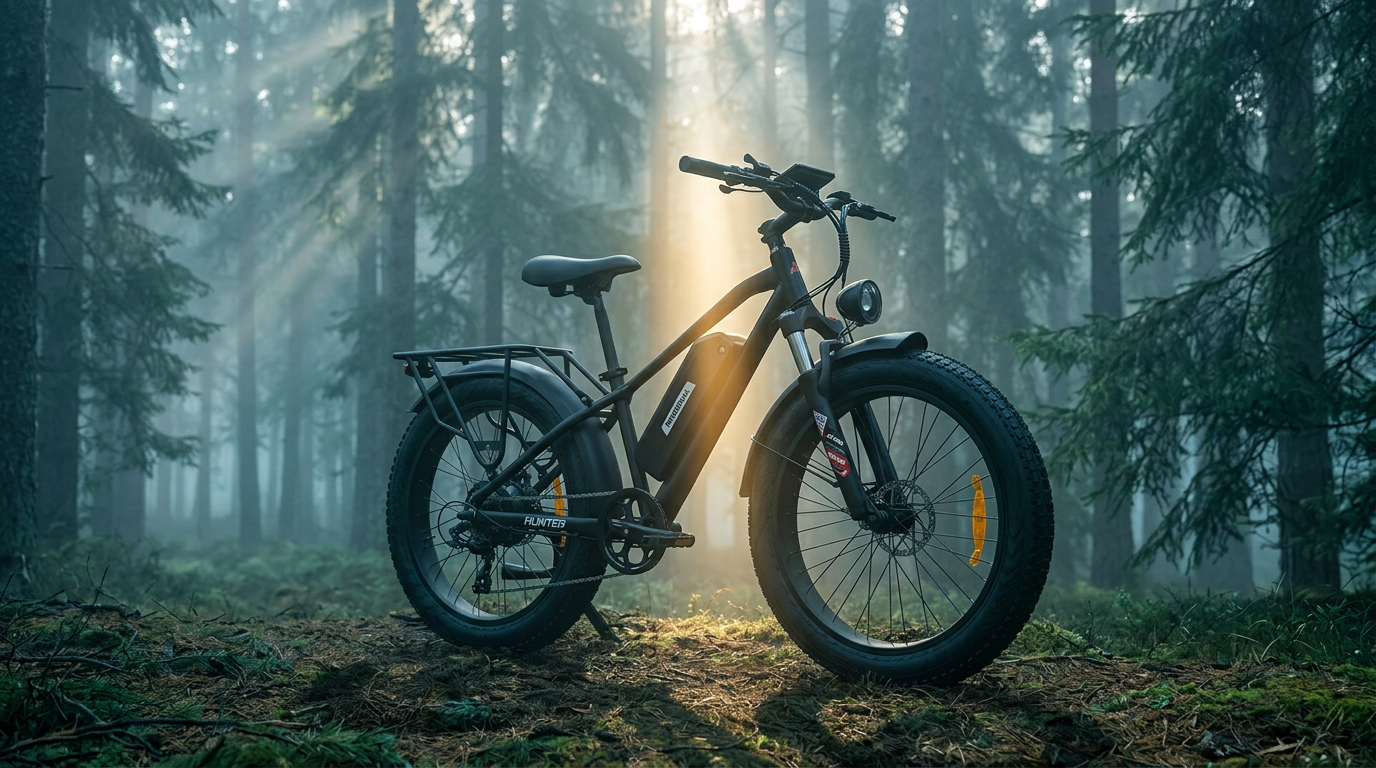
Kingbull Hunter 2.0 Review: The Budget Fat-Tire Hunting E-Bike — Specs, Range & Verdict
A 720Wh Samsung battery, a 750W motor, 26" × 4" fat tires, and a quiet hub drive wrapped in a hardtail at the lowest entry price in the Kingbull lineup. Here's the honest take on the brand's hunting and trail rig — and who should actually buy it.
Disclosure: This page contains affiliate links. We may earn a commission at no extra cost to you.
TL;DR
The cheapest real Kingbull, dressed for the backcountry
The Kingbull Hunter 2.0 is the budget fat-tire hardtail in the lineup. You keep the 750W motor, hydraulic brakes, and 26" × 4" tires that make the Rover 2.0 great — you give up the rear shock and torque sensor. For hunters, scouters, and trail riders who want a quiet, capable e-bike at the lowest Kingbull price, it's the smartest entry point in the catalog.
- Motor
- 750W hub
- Battery
- 720Wh
- Top speed
- 28 MPH
- Range
- Up to 55 mi
- Tires
- 26" × 4"
- Weight
- ~74 lbs
What we like — and what we don't
Pros
- Lowest entry price to the Kingbull fat-tire lineup
- Same 750W motor and hydraulic disc brakes as flagship Kingbulls
- 26" × 4" fat tires float over sand, snow, mud, and singletrack
- Hardtail layout is lighter (~74 lbs) and easier to handle than full-suspension siblings
- Camo colorway and quiet hub motor make it a real hunting / scouting rig
- Class 3 (28 MPH) — no artificial speed cap like the Discover ST 2.0
Cons
- No rear suspension — long technical descents get rough
- Cadence pedal assist instead of a torque sensor — less natural feel
- 720Wh battery is mid-pack; EX Titan and Trekker carry 960Wh
- Heavier than a standard MTB — not built for shouldering up hike-a-bikes
- Stock saddle is firm — most riders swap it within a month
Design & build quality
The Hunter 2.0 uses a 6061 aluminum hardtail frame with a clean, MTB-style geometry. The battery integrates into the down tube and locks in place; it charges on or off the bike. The camo paint isn't a sticker — it's a proper finish, and Kingbull also offers a stealthy matte black if you'd rather not advertise where you're going.
Build quality is genuinely good for the entry price. You get hydraulic disc brakes with 180mm rotors, a Shimano 7-speed drivetrain, a front suspension fork with lockout, integrated front lighting, and a brake-activated rear light. Welds are clean, accessory mounts are useful, and the bike ships ~85% assembled.
Motor, battery & real-world range
The Hunter 2.0 runs the same 750W rear hub motor (1,000W peak) used across the Kingbull lineup, paired with cadence-based pedal assist. Cadence means the motor engages when you start pedaling and holds the assist level you've chosen, regardless of how hard you're pushing. It's predictable and easy to learn — just less natural-feeling than the torque sensor on the EX Titan or Verve.
The 720Wh Samsung battery is mid-pack in the Kingbull lineup. Kingbull claims up to 55 miles in eco pedal assist. Realistically, expect 28–42 miles of mixed riding with throttle use, fat-tire rolling resistance, and a rider over 180 lbs. Pure flat-road eco pedaling can stretch closer to the claimed 55-mile figure.
Top speed is 28 MPH on pedal assist as a Class 3 e-bike, with throttle capped at 20 MPH so you can still legally use throttle on Class 2 paths. The hub motor is quiet — quieter than a mid-drive — which is part of why this bike works as a hunting rig.
Ride quality & comfort
The 26" × 4" fat knobby tires are the headline. They float over loose dirt, leaf litter, sand, and shallow snow that would stop a standard MTB e-bike. On hardpack and pavement you'll feel the rolling resistance — that's the trade-off — but on the kind of terrain you'd actually take a hunting bike onto, the grip is the point.
A front suspension fork with lockout handles roots, rocks, and trail chatter up front. There's no rear shock, so long technical descents will rattle you — for sustained chunder you'd want the full-suspension EX Titan or Rover 2.0. At ~74 lbs, the Hunter 2.0 is actually one of the lighter fat-tire Kingbulls, which makes loading it onto a 2" hitch rack or into a truck bed more manageable.
Who the Kingbull Hunter 2.0 is for
Buy it if you…
- • Hunt, scout, or run trail cams and want quiet, motorized access
- • Want the cheapest way into a real fat-tire Kingbull
- • Ride mostly singletrack, fire roads, gravel, snow, or sand
- • Prefer a lighter hardtail over a heavier full-suspension rig
- • Want Class 3 (28 MPH) speed without paying premium money
Skip it if you…
- • Ride sustained technical descents — pick the EX Titan or Rover 2.0
- • Want the biggest battery — the EX Titan (960Wh) is the range king
- • Commute on pavement — the Trekker or Discover ST 2.0 fits better
- • Need a folding bike — that's the Literider 2.0 or Verve
- • Plan to haul kids or cargo — the Voyager 2.0 is purpose-built for that
Kingbull Hunter 2.0 vs the rest of the lineup
vs Kingbull Rover 2.0: The Rover 2.0 is our Editor's Choice fat-tire all-rounder — full suspension, torque sensor, more refined feel. The Hunter 2.0 is the lighter, cheaper hardtail with the same motor, brakes, and tires. Pick the Hunter if price matters most; pick the Rover if you can stretch for full suspension.
vs Kingbull EX Titan: The EX Titan is the premium adventure bike — 960Wh battery, full suspension, torque sensor, 450 lb payload. The Hunter 2.0 is the budget hardtail with a smaller 720Wh battery. Pick the EX Titan for long backcountry days; pick the Hunter for shorter, scrappier rides at half the price.
vs Kingbull Discover ST 2.0: Different jobs. The Discover ST 2.0 is a step-through city + light off-road bike capped at 20 MPH for trail-legal access. The Hunter 2.0 is a fat-tire Class 3 hardtail for real dirt and hunting use. Buyer overlap is minimal.
Verdict
The Kingbull Hunter 2.0 is the smartest cheap way into the Kingbull fat-tire ecosystem. You're not buying it for the plushest ride or the biggest battery — the EX Titan and Rover 2.0 win those fights. You're buying it because it keeps the 750W motor, hydraulic brakes, and 26" × 4" tires that make a Kingbull a Kingbull, drops the rear shock and torque sensor to hit the lowest entry price, and dresses the whole thing in camo so it disappears into the woods. For hunters, scouts, and trail riders on a budget, that's exactly the point.
Kingbull Hunter 2.0 full specs
| Motor | 750W rear hub (1,000W peak) |
|---|---|
| Battery | 48V / 15Ah · 720Wh Samsung cells |
| Claimed range | Up to 55 mi (pedal assist, eco) |
| Realistic range | 28–42 mi mixed riding |
| Top speed | 28 MPH (Class 3) |
| Tires | 26" × 4" fat knobby |
| Brakes | Hydraulic disc, 180mm rotors |
| Drivetrain | Shimano 7-speed |
| Frame | 6061 aluminum hardtail |
| Suspension | Front suspension fork (lockout) |
| Sensor | Cadence pedal assist |
| Weight | ~74 lbs |
| Payload | 330 lbs |
| Display | LCD with USB-out |
| Lighting | Integrated front + brake-activated rear |
| Colors | Camo / matte black |
Kingbull Hunter 2.0 FAQ
+Is the Kingbull Hunter 2.0 worth it?
Yes, if you want the cheapest way into the Kingbull fat-tire lineup without giving up the 750W motor or hydraulic brakes. It's the best-value pick for hunters, scouts, and trail riders who don't need full suspension.
+How fast does the Kingbull Hunter 2.0 go?
28 MPH on pedal assist as a Class 3 e-bike. Throttle-only top speed is 20 MPH, matching federal Class 2 rules so you can still legally use throttle on Class 2 paths.
+What's the real-world range of the Kingbull Hunter 2.0?
Kingbull claims up to 55 miles in eco pedal assist. In real mixed riding with throttle use, fat-tire rolling resistance, and a rider over 180 lbs, plan for 28–42 miles per charge. Pure flat-road eco riding can stretch closer to the claim.
+Kingbull Hunter 2.0 vs Rover 2.0 — which should I buy?
Buy the Hunter 2.0 if you want the lowest price and the lightest fat-tire Kingbull, and you can live without a rear shock. Buy the Rover 2.0 if you want full suspension, a torque sensor, and a more refined ride for the same daily use cases.
+Is the Hunter 2.0 a good hunting e-bike?
Yes — it's purpose-marketed for that. The quiet hub motor, camo paint, 750W of torque, and fat tires that handle leaf litter, mud, and snow make it well suited for scouting, stand access, and quiet backcountry travel. Add a rear rack for gear.
+Can the Hunter 2.0 handle real mountain bike trails?
Yes for blue / mellow black flow trails, fire roads, doubletrack, and most XC singletrack. For technical descents with sustained chunder or drops, the full-suspension EX Titan or Rover 2.0 will be more comfortable and more controlled.